What a Nikah invitation has to say
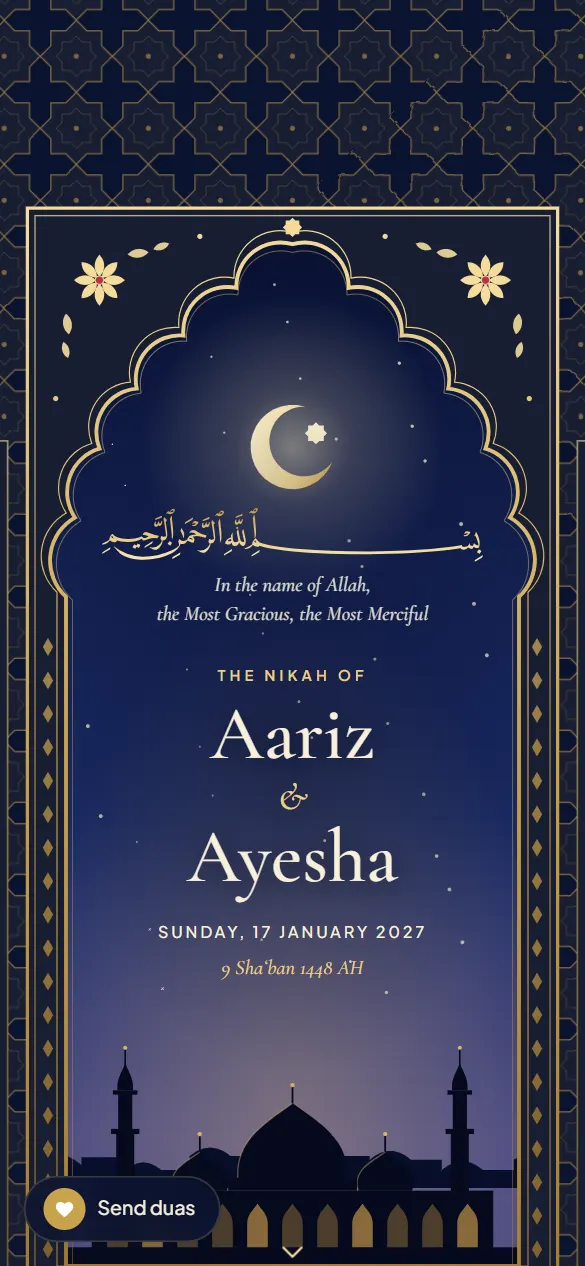
A guest needs four things: whose Nikah, which day in both calendars, when, and where. Everything else can wait. So the first screen is the Bismillah, the names, and the dates. The Nikah card then carries the timing as a highlighted line, for example Nikah: After Asr prayer, with directions to the masjid or the hall.
Live preview, scroll it like a guest would.
Wording families recognise
The default message is one many families use, and you can change every word:
With the blessings of Allah and our beloved families, we cordially invite you to the Nikah of our children. Your presence and duas will make the day complete.
For Urdu phrasing such as Aqd-e-Nikah and ba'ad Namaz-e-Asr, and for samples from the bride's side and the groom's side, see the Nikah wording guide.
A verse, if you would like one
Add Surah Ar-Rum 30:21 in translation, edit it, or leave it out. It sits on its own, with nothing moving across it.
Send it the way you already do
The whole invitation is one link. Send it on WhatsApp family by family, and add a guest's name to the link so it greets them personally. Relatives abroad can watch a live stream of the Nikah inside the invitation if you add one.
Free to build. Pay once to share.
Create your Nikah invitationFAQ
How do I show the time as after Asr or after Isha?
Open the Nikah event and add Nikah time and Hijri date. Write After Asr prayer in the time window and it appears as a highlighted line on the card.
Is the Hijri date calculated for me?
A calculated date appears by default. India's moon-sighted date can differ by a day, so you can type the date your family is using and that one is shown instead.
Can I add a note about separate seating?
Yes. Each event has a note for guests, which is where families usually mention separate arrangements for ladies, dress or parking.
Can the bride's family send it, and the groom's family send their own?
Yes. Each family can have its own invitation and link, with the wording and events that suit it.