
If you have received a Muslim wedding card in India, Pakistan or Bangladesh, you have probably seen the number 786 at the top. It is such a familiar sight that many people print it without knowing why. Here is where it comes from, and how families think about it.
What 786 means
786 is the total of the letters in the Arabic phrase Bismillah ir-Rahman ir-Rahim, "In the name of Allah, the Most Gracious, the Most Merciful", when each letter is given its value in the abjad numeral system. So the number stands in for the phrase.
Why it appears on wedding cards
Muslims begin important things with the Bismillah, and a wedding invitation is no exception. But a printed card has a short life. After the wedding it may be thrown away, used as scrap, or trodden underfoot, and many families are not comfortable with Allah's name being treated that way. Writing 786 in its place lets them mark the invitation without that worry.
The custom is most associated with South Asia. It is far less common in the Arab world.
What scholars say
Scholars do not all see it the same way, so it is worth asking someone you trust. In general:
- Many say the number does not carry the blessing of actually saying or writing the Bismillah, and that nobody should treat it as equal to the words.
- Some consider writing it acceptable where there is a real concern that a printed Bismillah could be disrespected.
- Others discourage it, since it has no basis in early practice, and prefer the phrase itself, written and handled with care.
We are not scholars, and this is a summary rather than a ruling. It is your family's decision.
How families choose today
Broadly, there are four choices on an invitation:
- The Bismillah in Arabic. Many families prefer the words themselves.
- The Bismillah in English, for guests who do not read Arabic.
- 786, by long habit or out of concern for how a card might be treated.
- Nothing at the top, with a line such as With the blessings of Allah in the wording instead.
Does a digital invitation change anything?
For some families, yes. The concern behind 786 is about paper: a card that can be thrown away, stepped on or wrapped around something. A link does not end up in the bin. That is one reason some families who would never print the Bismillah are comfortable with it on a digital invitation, although a phone can of course be carried anywhere, and people differ on this as well. As with the rest, ask whoever guides your family.
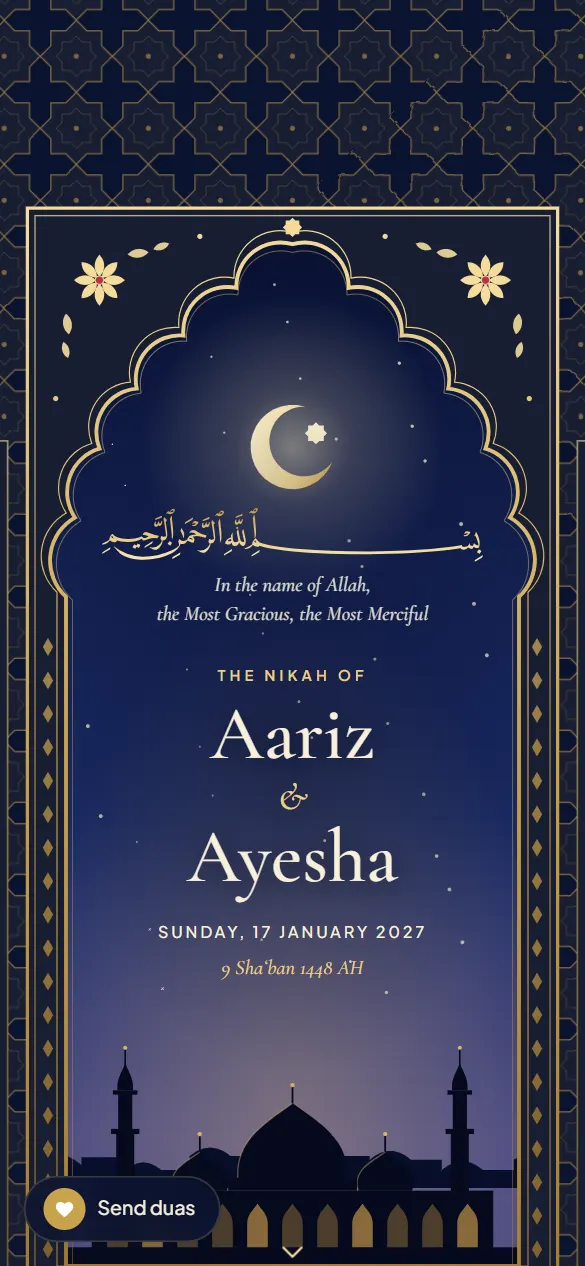
Live preview, scroll it like a guest would.
Bismillah in Arabic, in English, 786 or nothing. Your family's choice.
See the Muslim wedding invitationFAQ
Is 786 an Islamic number?
It has no special status in the Quran or Hadith. It is a numeric way of referring to the Bismillah that developed much later and became common in South Asia.
How is 786 calculated?
Each Arabic letter has a traditional number in the abjad system. Adding the values of all the letters in *Bismillah ir-Rahman ir-Rahim* gives 786.
Should I write 786 or Bismillah on my Nikah invitation?
Either is common, and so is leaving both out. Many families ask an elder or a scholar they trust, and follow what their family has always done.
What should I write if some guests are not Muslim?
The Bismillah in English works well on a mixed guest list, since everyone can read it. See the [Nikah wording guide](/blog/nikah-invitation-wording) for samples.
Ready to try it?
Build your animated invitation free. Pay once, only when you share.
Names, events, photos and music in about five minutes, live on WhatsApp the moment you pay.
#muslim#nikah#786#bismillah