
A shloka at the top of an invitation does two things: it asks for a good beginning, and it tells guests something about your family. Most cards carry just one. These six are the ones families reach for most, in English letters so everyone on the list can read them, with a plain meaning beneath each.
Spellings vary widely and all of them are understood. Use the wording your family or your priest uses, and ask them to look it over before you send it.
For a good beginning
Vakratunda Mahakaya, Suryakoti Samaprabha, Nirvighnam Kuru Me Deva, Sarva Karyeshu Sarvada.
Meaning: O Lord with the curved trunk and mighty body, radiant as a crore suns, keep every undertaking free of obstacles, always. A prayer to Ganesha, and the most common opening on a Hindu invitation.
Shri Ganeshaya Namah
Meaning: Salutations to Lord Ganesha. The simplest invocation of all, and enough on its own.
For the blessing itself
Mangalam Bhagavan Vishnuh, Mangalam Garudadhvajah, Mangalam Pundarikakshah, Mangalaya Tano Harih.
Meaning: Auspicious is Lord Vishnu, auspicious is the one with Garuda on his banner, auspicious is the lotus-eyed one. May Hari be the source of all that is auspicious. Widely used for weddings and new beginnings.
Sarva Mangala Mangalye, Shive Sarvartha Sadhike, Sharanye Tryambake Gauri, Narayani Namostute.
Meaning: O auspicious one, who brings every good thing to fulfilment, our refuge, three-eyed Gauri, salutations to you. A prayer to the Goddess, and a good choice for a family devoted to Devi.
For the marriage
Mangalyam Tantunanena, Mama Jeevana Hetuna, Kanthe Badhnami Subhage, Tvam Jeeva Sharadam Shatam.
Meaning: This sacred thread is the cause of my life. I tie it around your neck, O blessed one. May you live a hundred years. Recited as the thali is tied, so it belongs especially to South Indian invitations.
From Tamil
Anbum aranum udaiththaayin ilvaazhkkai, panbum payanum adhu.
Meaning: If love and virtue fill a home, that is its grace and its reward. Thirukkural 45, from the chapter on family life. A lovely choice for a Tamil family, and it needs no religious setting.
How to place it
- At the very top, above the parents' names, on a formal invitation.
- On its own, with space around it. One shloka given room reads better than two crowded together.
- Under the mark, if you are using Ganesha, Om or a lamp.
Give the meaning only if your guest list needs it. On a digital invitation you can write the shloka in English letters and let the Devanagari, Tamil or Malayalam go on the printed card.
For the rest of the card, see Hindu wedding invitation wording.
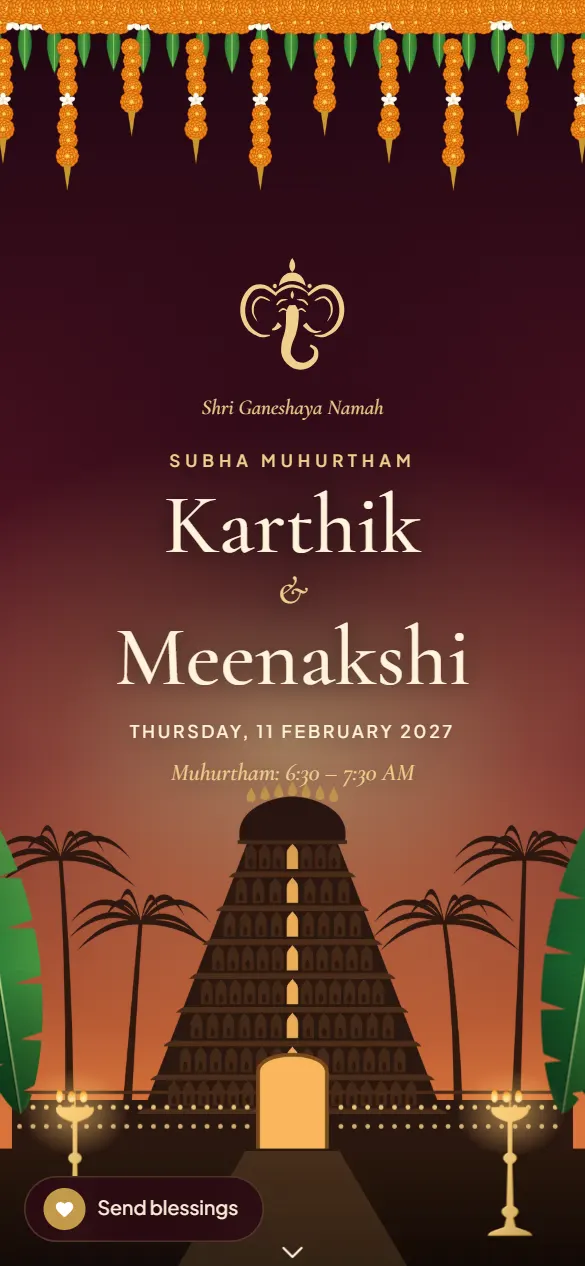
Live preview, scroll it like a guest would.
Temple doors, lamps at dusk, and the shloka your family uses.
See the temple wedding invitationFAQ
Which shloka is most common on a Hindu wedding invitation?
The Vakratunda shloka to Ganesha is probably the most common, along with the short Shri Ganeshaya Namah. Mangalam Bhagavan Vishnu is very widely used too.
Do I have to include a shloka?
No. Plenty of invitations have none, and a family message does the same work. Use one if it means something to your family.
Can I write it in Tamil, Malayalam, Telugu or Hindi script?
Yes, and many families do. Have someone who reads the script check it, since a small error in a printed shloka is hard to take back.
Which one suits a Tamil wedding?
Mangalyam Tantunanena is recited at the moment the thali is tied, so it is very fitting. Thirukkural 45 is a good choice if you would like Tamil words and no Sanskrit.
Ready to try it?
Build your animated invitation free. Pay once, only when you share.
Names, events, photos and music in about five minutes, live on WhatsApp the moment you pay.
#hindu#shloka#wording#south-indian