
Hindu wedding ceremonies run in a broad order, but no two regions agree on all of it. A Punjabi wedding, a Tamil wedding and a Kerala wedding can share a sacred fire and very little else. This guide lays out the usual order of Hindu wedding rituals for North and South India, then answers the question that matters when you sit down to write the card: which of these functions do your guests actually need to know about?
Treat it as a map rather than a rulebook. Your family, your community and your priest decide what happens on the day.
North Indian Hindu wedding rituals and functions, in order
| Function | What happens | On the invitation? |
|---|---|---|
| Roka | The families formally agree to the match | Usually not, it is for close family |
| Sagai | The engagement, with an exchange of rings | Often its own event |
| Tilak | The bride's family blesses the groom | Usually close family only |
| Haldi | Turmeric paste is applied to the couple | If guests are invited |
| Mehendi | Henna is applied to the bride and her guests | Yes, its own event |
| Sangeet | An evening of music and dance | Yes, its own event |
| Baraat | The groom's procession to the venue | Yes, with the time and start point |
| Milni and Jaimala | The families meet, and the couple exchange garlands | A line in the running order |
| Kanyadaan | The bride's parents give her hand | A line in the running order |
| Pheras | The couple circle the sacred fire | Give the muhurat |
| Sindoor and mangalsutra | The groom applies sindoor and ties the mangalsutra | A line in the running order |
| Vidaai | The bride's farewell to her family | Optional |
| Griha Pravesh | The bride enters her new home | No, it is for the family |
| Reception | Dinner and celebration | Yes, its own event |
Haldi and mehendi often swap places, and some families combine them. Many also merge the roka and the sagai.
South Indian wedding rituals, by region
The heart of a South Indian wedding is usually the tying of the thali at the muhurtham, often in the morning, and the day tends to be shorter.
Tamil. Nichayathartham, the engagement. Nalangu, playful games for the couple. In many Brahmin families, Kasi Yatra and Oonjal. Kanyadaanam, Mangalya Dharanam at the muhurtham, Saptapadi and the reception. Exact wording is in the Tamil wording guide.
Telugu. Nischitartham, then Pellikuthuru and Pellikoduku, when the bride and groom are prepared with turmeric. Jeelakarra Bellam, a paste of cumin and jaggery placed on each other's heads at the muhurtham. Mangalya Dharana, Talambralu, Saptapadi and Appagintalu, the bride's farewell. Exact wording is in the Telugu wording guide.
Kannada. Nischitartha, Kashi Yatre, Dhare Herdu, Mangalya Dharane and Saptapadi. Exact wording is in the Kannada wording guide.
Kerala. Nischayam, the formal engagement. Thalikettu at the muhurtham, then pudava kodukkal, the giving of the cloth to the bride. Sadya, the feast served on banana leaf. Often the whole wedding moves quickly, so guests watch the time closely. See the Kerala wording guide.
Which functions belong on the invitation?
One simple test sorts them all: if a guest has to be somewhere at a certain time, it is an event. If it happens while they are already there, it is a line in the running order.
So the mehendi, sangeet, wedding and reception each need a date, a time and a venue. The jaimala, kanyadaan and pheras do not, because a guest at the wedding will see them. Listing them is a courtesy, not a necessity, and it helps guests who are new to the customs.
Leave out what is only for family. If different guests are invited to different functions, send them different lists rather than one long card.
A sample programme
Mehendi: Friday, 12 February, from 4:00 PM, at home Sangeet: Saturday, 13 February, from 7:30 PM, Shree Mangal Gardens Baraat: Sunday, 14 February, 6:00 PM, from Hotel Mangal Residency Wedding: Sunday, 14 February, muhurat at 7:30 PM, Shree Mangal Gardens Reception: Monday, 15 February, from 7:30 PM, Shree Mangal Gardens
For the lines of the invitation itself, see Hindu wedding invitation wording.
Every function on its own card
A long programme is where a paper card struggles most, with five venues and a map on none of them. On a Hindu wedding invitation from ShareMyInvite, each function is its own card with its own date, venue, directions and calendar button. The running order goes inside the card it belongs to, under the title Order of rituals, and the muhurtham window is highlighted.
Gopuram Deepam and Kerala Melam open with temple doors and a brass bell. Change a time later, and everyone's link shows the new one without you sending anything again.
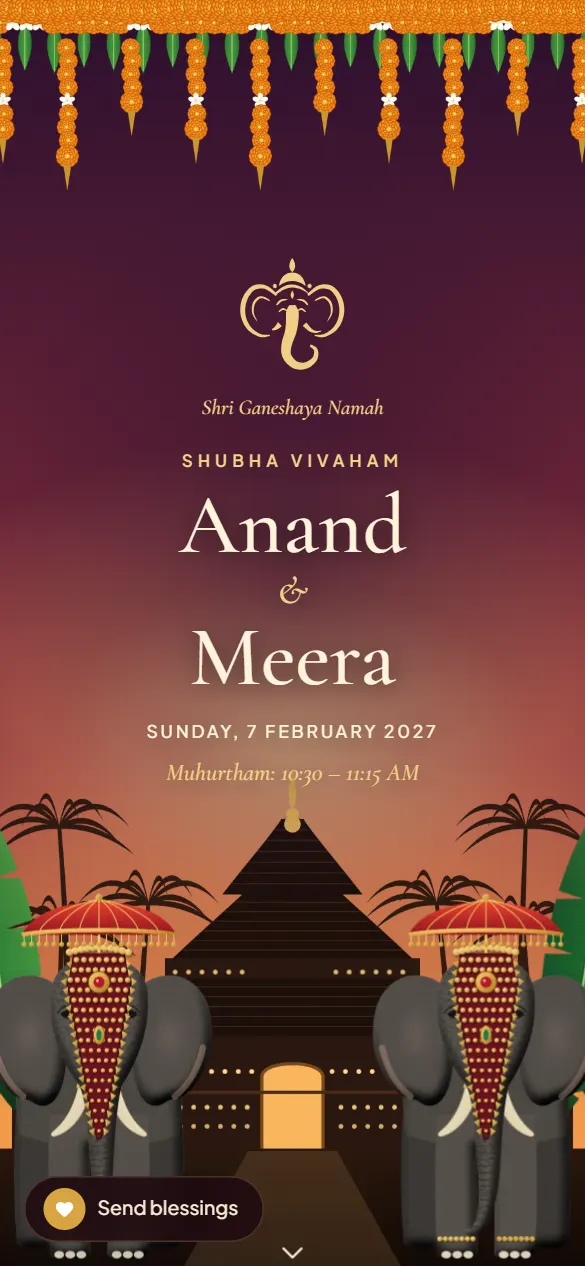
Live preview, scroll it like a guest would.
Every function on its own card. Free to build, and you pay once to share.
See the Hindu wedding invitationFAQ
What is the order of a Hindu wedding?
In a typical North Indian wedding the order is roka, sagai, haldi, mehendi, sangeet, baraat, jaimala, kanyadaan, pheras, sindoor, vidaai and the reception. South Indian weddings follow their own sequences, built around the tying of the thali at the muhurtham.
How many days does a Hindu wedding last?
It varies. Many North Indian weddings spread over three to five days of functions, while many Kerala and Tamil weddings hold the main ceremony in a single morning, with a reception that day or soon after.
Which comes first, haldi or mehendi?
Either. Families differ, and some hold both on the same day. Ask your family's elders or your priest, then put each on the invitation in the order you settle on.
What is the difference between pheras and saptapadi?
Pheras are the rounds the couple make around the sacred fire. Saptapadi means seven steps, each tied to a vow. Some communities treat them as one moment and others as two, so use the word your priest uses.
Should I list every ritual on the invitation?
No. List what guests must attend at a set time, and keep the rest as a short running order inside the main event. Guests read an invitation to find out where to be and when.
Ready to try it?
Build your animated invitation free. Pay once, only when you share.
Names, events, photos and music in about five minutes, live on WhatsApp the moment you pay.
#hindu wedding ceremonies#hindu wedding rituals#wedding functions#south indian wedding rituals#invitation planning